How AI Answer Engines Are Rewriting The Visibility Playbook For India’s Schools And Hospitals

A parent in Banjara Hills opens ChatGPT and types: “Best CBSE school for a Class 8 student who needs strong math support, Hyderabad.” A patient in Gurugram asks Perplexity: “Best orthopedic surgeon for knee replacement near me.” Neither gets ten blue links. Each gets one confident, synthesised answer – a handful of names, sometimes even a reason why.
This is no longer an edge case. It is happening, quietly, across India’s school-admission funnels and hospital patient-acquisition journeys, often before a single click lands on a traditional search results page.
The instinct inside most marketing teams is panic: “Is SEO dead?” The evidence, and the experience of operators who have tracked AI visibility since this shift began, says no. SEO is not dying. It is expanding into a new layer called AEO, Answer Engine Optimisation. And the foundations that win in both are, in large part, identical.
For categories built on trust, outcomes and expertise – schools and hospitals – this is less a threat than a long-overdue reward for the institutions that have actually done the work.
The Big Shift: SEO Is Expanding Into AEO, Not Being Replaced By It
For two decades, “visibility” meant one thing: where you ranked on Google or Bing. SEO (Search Engine Optimisation) is the discipline of winning that race – through content quality, backlinks and technical structure – judged by search engine crawlers, with paid ads running alongside organic results.
AEO (Answer Engine Optimisation) is the newer, parallel race: visibility inside the answers generated by AI systems – ChatGPT, Perplexity, Gemini, Google’s AI Overviews. Here, the ranking signals change shape. What matters is EEAT – Experience, Expertise, Authoritativeness, Trustworthiness – entity clarity, and authority across the web. Crucially, the AI model decides what to trust, not what to rank, and no ad budget can buy a citation inside an AI answer.
The term AEO is barely a year old. The practices behind it are not new at all. What makes great SEO and great AEO is fundamentally the same: genuine expertise, original content, and trustworthy information. The two disciplines don’t compete for the same budget – they reinforce each other.
How AI Actually Builds Its Answer – And What Today’s Search Results Page Really Looks Like
To act on AEO, it helps to understand the mechanics. AI systems generate answers in three ways. First, trained knowledge – information absorbed during model training from the web, books and structured data. Second, structured data – schema markup, directories and machine-readable content, which is how AI identifies what an institution actually is and does. Third, and increasingly, real-time browsing – many AI systems now read live web pages when answering a query, meaning your content is read, not just remembered from a training snapshot months or years old.
This is also why hallucination matters: AI can generate confident, fabricated answers, which is why these systems lean on trustworthy, well-documented sources whenever one is available.
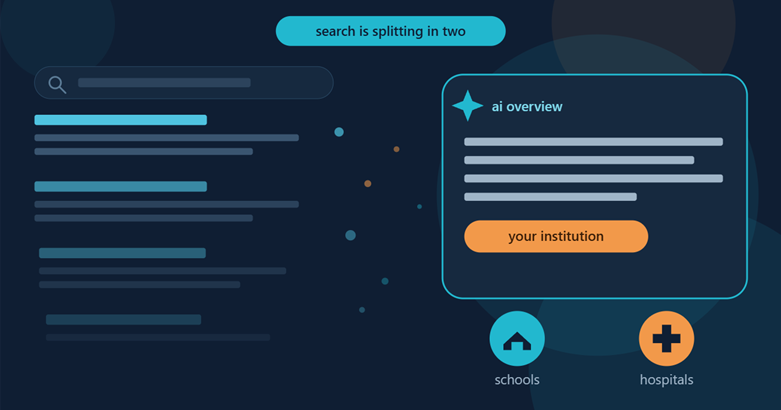
Meanwhile, the search results page has quietly restructured. At the top sits the AI Overvie – a synthesised answer, where AEO work now lives. Below it, sponsored results, where Google Ads spend still operates. The Google Business/Maps local pack remains a strong local-intent block – keep your GBP immaculate. Organic results – classic SEO – still rank and still convert. And paid placements alongside AI answers are coming next. AI doesn’t rank pages. It chooses what to trust.
EEAT Is The Single Framework Now Governing Both Google Rankings And AI Trust
Google’s EEAT framework was built to evaluate search-ranking quality. AI systems apply the exact same logic when deciding what to cite. For schools and hospitals, it translates into four very concrete tests.
Experience – does the creator have real, lived experience with the subject? A principal writing about curriculum changes they implemented, or a surgeon describing realistic post-operative expectations, passes. Generic “top tips” content written by an agency with no domain knowledge does not.
Expertise – is subject-matter knowledge demonstrated, not just claimed? Teachers publishing pedagogy insights and openly sharing academic outcomes, or doctors with documented credentials, specialty depth and clinical focus, pass. Vague, unauthored department pages do not.
Authoritativeness – is the creator recognised by others in the field? A principal quoted in education media, a doctor cited in health publications, and digital PR earning backlinks from credible sites – all pass. An isolated web presence with no external mentions does not.
Trustworthiness – is the information honest, specific and consistent everywhere? Outcome-based testimonials and an identical Name/Address/Phone (NAP) across every directory pass. Vague reviews, inconsistent listings, and broken promises in marketing copy do not.
What Moves AI Visibility Today – And What Has Quietly Stopped Mattering
Some of the old SEO toolkit still works exactly as before. Some of it has changed shape. And one new layer – EEAT-led content – now sits at the centre of both.
What reliably improves AI visibility: EEAT-led content built on genuine expertise and real experience; Schema.org markup that helps AI identify entity type, services, location and staff; FAQ-structured pages in natural Q&A format, mirroring exactly how AI retrieves answers; consistent NAP across every platform; external mentions and PR that build the authority AI trusts; reviews spread across Google, Practo, JustDial and Quora; and original insights – data, outcomes, case studies – that only your institution can provide.
What has changed, but not disappeared: meta tags are no longer quoted by AI but still help indexing; keyword stuffing is dead, but natural, relevant terminology still signals expertise; H1/H2 structure and clean internal linking still matter for both SEO and AEO; Google Ads spend does not influence AI answers, though ads still appear alongside them; and keyword density in the old sense is useless, while relevance and context remain very important.
The takeaway: strong SEO foundations still improve AI visibility. They are complementary, not competing.
From Invisible To AI-Legible: The Practical Shift Schools And Hospitals Must Make
The gap between “invisible to AI” and “AI-legible” is rarely about budget. It is about specificity.
For schools: “nurturing young minds” is invisible; “94% of our Class 10 students scored above 85%” is AI-legible. A generic department list is invisible; rich teacher profiles with documented pedagogy philosophy are AI-legible. Reviews on Google alone are invisible; reviews spread across Google, JustDial, Shiksha.com and Quora are AI-legible. No external media presence is invisible; a principal quoted in education publications builds authority that AI recognises.
For hospitals: “Department of Cardiology” with no depth is invisible; a dedicated page on “Knee Replacement in Hyderabad” with documented outcomes is AI-legible. A staff photo and name only is invisible; full doctor profiles – qualifications, specialties, languages, philosophy – are AI-legible. Five hundred surgeries with zero online documentation are invisible; a doctor publishing health content and quoted in the media is trusted by AI. Reviews on Google alone are invisible; reviews across Practo, Google, JustDial and Healthgrades are AI-legible.
None of this requires new infrastructure. It requires institutions to say, in writing and in detail, what they already know to be true about themselves.
The Practitioner Playbook: Four Habits That Are Already Moving The Needle
These four practices come from businesses that have tracked AI visibility monthly since 2022.
Track AI rankings monthly. Just as you track Google positions for your top terms, run a monthly AI ranking check – search Claude, ChatGPT and Perplexity for your top 5–10 queries (“best cardiac hospital Hyderabad”, “CBSE school Banjara Hills”). Document where you appear and how it changes, and make it a standing item in marketing reviews.
Answer questions publicly, at scale. Quora remains a powerful distributed-authority builder. Institutions that answered real user questions comprehensively and consistently became the default reference for AI systems in their categor – one practitioner reached the #1 global Quora rank for a specific category, and AI noticed.
Invest in digital PR. Genuine press coverage, expert citations and quality backlinks remain among the highest-leverage SEO investments, and feed directly into AI entity authority. A principal quoted in a newspaper, a specialist featured in a health magazine: both cascade through search rankings and AI training data.
Show real experiences on social. Authentic parent, student and patient moments, not polished brand posts, create the trusted signals AI increasingly incorporates. This is the social layer of EEAT.
Content That Wins In Both Search And AI Shares Four Common Traits
Original content mattered decades ago. It matters even more now — the format has evolved, the principle hasn’t.
Real questions, real answers. Write FAQs in natural language (“Do you have a NICU?” not “Neonatal care services”), answer the follow-up question rather than just the surface query, and place summaries at the to – AI retrieves key answers quickly.
Original insights only you can provide. Outcome data – exam results, recovery rates, satisfaction scores; process transparency – how curriculum or treatment decisions are made; and teachers’ and doctors’ philosophies, in their own words.
Trust signals that are specific. “My daughter improved from 55% to 83% in maths over one term” beats “great school.” “Dr. Mehta explained every step before surgery” beats “good doctor.” Named, verifiable case studies compound this further.
Structural clarity for machines and humans. Schema marku – FAQPage, LocalBusiness, MedicalOrganization, EducationalOrganization; a clean H1/H2/H3 hierarchy instead of walls of text; and bullet-point summaries that AI can extract directly.
The 90-Day Roadmap: From Foundation To Compounding Authority
SEO and AEO are not one-time projects, they compound. A 90-day plan builds the foundation; the work after that is tracking, iterating and expanding monthly.
Month 1 – Fix the Foundation: a complete, photographed and actively managed Google Business Profile; Schema.org markup across LocalBusiness, Medical/Educational Organisation, and FAQPage; an EEAT audit of every page; and an AI baseline, search your top 10 queries on Claude, ChatGPT and Perplexity, and document results.
Month 2 – Build EEAT Authority: 8-12 FAQ pages written in natural Q&A format by real experts; 10 specific, outcome-based testimonials per specialty or grade level; one external thought-leadership placement in a credible publication; and answers to your category’s top questions on Quora.
Month 3 – Measure & Expand: a monthly AI ranking report as a standing marketing-review item; authentic parent/student/patient social content, not brand posts; digital PR outreach to three target publications; and budget reallocation toward bottom-of-funnel intent and retargeting.
The Bottom Line: Institutions That Invested In EEAT All Along Are Not Behind – They Are Ahead
SEO is growing, not fading. High-quality, original, trustworthy, well-structured content dominates in the AI era, just as it always has. AEO is SEO expanding into a new surface: same foundations, new frontiers.
For India’s schools and hospitals, the message is clear-cut. Institutions that have spent years documenting real outcomes, building genuine teacher and doctor profiles, earning press mentions and managing reviews honestly across platforms are not playing catch-up in the AI era, they are already winning it, often without realising it.
AI doesn’t rank pages. It chooses what to trust. The task now is simple to state and hard to fake: audit your EEAT today, track AI visibility monthly, and invest in original, expert-authored content. Be the school, the hospital, that AI trusts.
LoEstro Advisors is an investment banking firm specializing in sell-side fundraising and M&A advisory, along with a strong consulting arm. Recognized as the #1 financial advisor in education in India, we are the advisor of choice to India’s blue-chip education businesses.
Over the last six years, we have grown to be one of India’s largest (in terms of M&A transactions) homegrown boutique investment banks, with $1.5 bn+ worth of combined deals closed across education, healthcare, consumer, and technology sectors.