
From Degrees to Deployable: How B2I Tech Skilling Is Rewiring India’s Universities

India makes more engineers than any other country in the world— 3million a year from some 9,000 colleges, with the number set to double by 2035. The world’s biggest talent pool, on paper. Look closer and it cracks: barely 42% are employable, and only about one in six gets hired straight out of college. India isn’t short on degrees. It’s short on graduates anyone can actually put to work.
Universities spent years trying to patch the gap themselves. A guest lecture here, a weekend bootcamp there, a frantic placement push in final year. None of it moved the needle. Then NEP mandates, rankings that now reward placements, and GCCs hiring faster than campuses can keep up turned skilling from optional to existential — and building it in-house is a game most colleges simply can’t win. So they’re buying it instead. The result: a $7 billion-plus market taking shape almost overnight, and a new class of partners quietly rewiring how India’s universities teach, place, and compete
Indian universities produce the World’s largest engineering talent pool, with a skilling gap it can’t fill alone
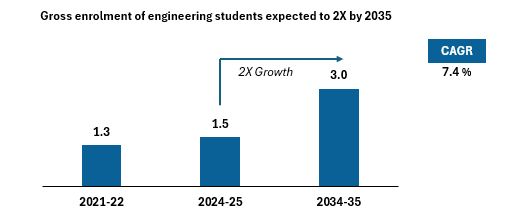
India’s GER is expected to double by 2034
India graduates over 3 million engineering students a year across 9,000+ colleges, and the pool is set to double by 2035 — but scale masks a structural failure.
Only ~42% of graduates meet employability standards and just ~17% are placed immediately, held back by outdated curricula, weak industry linkages, and severe faculty and infrastructure gaps (close to 56% of Tier 2–4 colleges lack adequate tech infrastructure).
The pressure is mounting: over 80% of Indian corporates now demand agentic-AI capability while the half-life of a tech skill has fallen to roughly three years, leaving institutions behind a curriculum cycle slowed by overlapping UGC–AICTE mandates and intensifying foreign-university competition. Neither institutions nor corporates can bridge this alone — creating structural demand for an embedded skilling partner delivering through both SaaS and instructor-led models.
NEP 2020 and the Placement Imperative Are Forcing Universities to Buy Skilling, Not Build It
For India’s universities, skilling has shifted from an optional enhancement to a competitive necessity and building that capability in-house is neither fast enough nor affordable enough to keep pace. Three forces are converging to make buying skilling the rational choice:
Policy mandate (NEP 2020): The policy requires at least 50% of learners to have vocational exposure by 2025 and targets lifting higher-education GER from ~28% to 50% by 2035, with AI, data analytics and IoT mandated into curricula from Grade 6 — explicitly pushing institutions toward industry linkages and co-developed courses they cannot deliver alone.The placement imperative (NIRF/NAAC): Graduate Outcomes now carry 20% of an institution’s NIRF score, and for engineering this explicitly includes placement statistics, median salaries and higher-studies data. With higher-ranked institutions winning more applicants and better cut-offs, placement performance has become a direct — and measurable — commercial lever.Industry pull via GCCs:
India’s Global Capability Centres are projected to grow from ~1,700 centres employing 1.9 million in FY2024 to 2,100–2,200 centres employing 2.5–2.8 million by 2030, with ~42% of roles filled by early-career talent and 86% of GCCs already building on AI/ML. The demand signal for job-ready, industry-current graduates has never been stronger.
The Education-to-Employment Gap is Creating a Multi-Billion-Dollar Institutional Skilling Market
TAM for B2I Skilling market
The opportunity is large and durable: ~9 million target students across ~8,600 private engineering colleges underpin a consolidated TAM of over $7 billion, compounding as enrolment grows and institutions are pushed to embed industry-aligned skilling.
Multiple business models are competing to capture this segment, distinguished by how deeply they embed into the institution:
Placement-stage skilling: Companies that train students only during the placement phase — capturing wallet share at the high-value final-year stage, though through a shallower, later-stage relationship.Full-degree delivery: Companies that run entire four-year programs, either leveraging college infrastructure or operating independently (e.g., NxtWave, Scaler) — the deepest model, owning the full student journey from enrolment to placement.Curriculum-embedded skilling: Companies that integrate directly into a college’s yearly curriculum (e.g., byteXL, iamneo) — the entry wedge: a sticky, recurring, per-student relationship built into the curriculum itself.
The Shift From One-Off Workshops to Deeply Embedded, Outcome-Linked Partnerships
The defining change is depth and duration of engagement. Embedded players now sign multi-year MoUs and integrate across the full degree, not a single workshop.
byteXL runs an “integrated college transformation model” that embeds AI-powered, cloud-native learning directly into academic delivery, and crossed 100,000 learners on its Nimbus platform by February 2025, with university MoUs spanning Parul, LPU, RAI, CBIT, Devbhoomi Uttarakhand and an MoU with AICTE itself.Sunstone operates across 20+ campuses in 15+ cities with 20,000+ students, co-designing curricula with employers and integrating AI-driven learning from the first semester.NxtWave’s NIAT delivers full four-year UGC/AICTE-approved B.Tech CSE degrees with embedded upskilling across 16 partner universities
Institutional Depth, Placement Data, and Employer Relationships Are the New Moats
In a market where content is rapidly commoditising, the real question is not who can teach — it is who can build a position competitors cannot copy. The winners’ advantages are precisely the things an institution cannot assemble on its own, and they reinforce one another into a moat that deepens with every cohort.
Faculty + content model: India is short an estimated 5 lakh+ teachers, so embedded providers fill a gap colleges simply cannot staff.Verifiable placement outcomes: with only ~10% of graduates industry-ready and NIRF grading placement at 20%, those who prove outcomes — and own the cohort data — become indispensable.Two-sided employer networks: AWS’s India alliance already links 51 employers to 49 institutions and Microsoft is training 10M Indians by 2030 — demand-side networks no single college can build.Multi-year integration & stickiness: full four-year embedded MoUs lock in curriculum, faculty and placement at once, so switching mid-degree disrupts students.
M&A and Funding Signals Are Consolidating the University-Skilling Space
Latest funding history of Edtech players operating in the B2I segment
Capital is following the contract structure. Because multi-year university MoUs convert into recurring, per-student revenue that compounds across cohorts and rarely churns mid-degree, the segment reads to investors like enterprise SaaS rather than consumer edtech — and both growth VCs and late-stage PE are leaning in.
On the demand side, the case is closed. NEP, placement-linked rankings, and GCCs short on job-ready talent have left universities with little choice but to bring in a partner, and that’s a $7 billion-plus market to chase. How you win it is the part still up for grabs. Placement-stage, full-degree, and curriculum-embedded players are each making a different call on how deep to go, and it’s genuinely too early to say which one lasts. But the economics underneath don’t really care which wins — revenue renews every academic year, and the lock-in runs on both sides. The model is unsettled. The revenue isn’t.
LoEstro Advisors is an investment banking firm specializing in sell-side fundraising and M&A advisory, along with a strong consulting arm. Recognized as the #1 financial advisor in education in India, we are the advisor of choice to India’s blue-chip education businesses.
Over the last six years, we have grown to be one of India’s largest (in terms of M&A transactions) homegrown boutique investment banks, with $1.5 bn+ worth of combined deals closed across education, healthcare, consumer, and technology sectors.