

A few years ago, protein powder was the clearest signal that someone had gotten serious about fitness. Today, walk into any gym, run club or workout class, and you will hear a different word being thrown around just as often: creatine.
If you have noticed friends, colleagues or people on your Instagram feed suddenly talking about creatine, you are not imagining a trend. You are watching a supplement quietly graduate from a niche bodybuilding product into something much bigger: a mainstream, everyday wellness habit, following almost the same path protein took a decade ago.
Here is what the data shows, and why this shift matters well beyond the gym:
Going Mainstream as Fitness Nutrition Becomes Part of Everyday Life
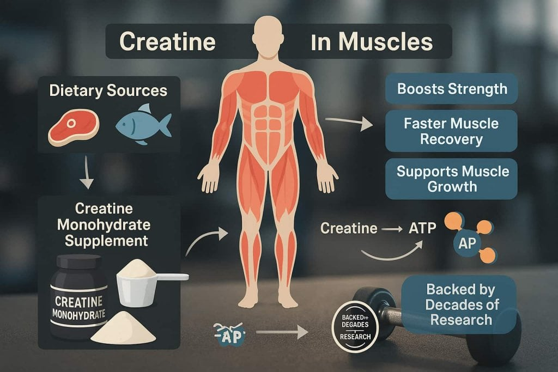
Creatine itself is not new. It has been studied for decades, and it carries one of the deepest research bases of any sports supplement available today. The International Society of Sports Nutrition considers creatine monohydrate the single most effective nutritional supplement for improving high-intensity exercise performance and building lean muscle during training. What has changed is not the science. It is the story being told around it.
The old pitch was narrow: creatine equals bodybuilding, equals heavy lifting, equals bulking up. Useful if you were chasing muscle mass, irrelevant otherwise.
The new pitch is far broader: strength, muscle preservation, workout recovery, daily energy, and increasingly, brain health and healthy ageing. That reframing matters commercially because it expands the addressable audience from “people who lift weights” to “people who care about how their body and mind perform.” That is a dramatically larger group of consumers.
A Record Boom as the Market Enters Its Fastest Growth Phase
India’s broader sports nutrition and supplements market, which includes protein, creatine, amino acids and pre-workout products, was estimated at roughly 1.16 billion dollars in 2025, growing at around 12.5 percent a year, with a projected annual growth rate of nearly 13 percent through 2032. On that trajectory, the category is set to more than double in size within seven years.
India’s sports nutrition market in US$ Bn
India’s sports nutrition market in US$ Bn
Creatine is expected to grow faster than that overall market. Asia-Pacific creatine sales alone are estimated to be expanding at roughly 25 percent a year through 2030, according to Grand View Research. And the clearest real-world signal comes from inside the industry itself: MuscleBlaze, one of India’s largest sports nutrition brands, has said creatine recently overtook whey protein as its single largest product by sales volume, a category that was reportedly growing three times faster than the year before.
Protein has been the default entry point into supplementation in India for over a decade. Creatine catching up to, and in at least one major brand’s case, overtaking it, tells you this is no longer a niche interest.
The Top 5 Growth Drivers Shaping the Market Today
Several distinct consumer trends are converging at the same time, and together they explain why this like a durable habit forming.
1. Creatine is simply becoming mainstream: The typical customer journey used to be gym, then whey, then maybe creatine much later. Increasingly it is gym, then protein and creatine together from day one.
2. Women have become one of the biggest new growth pools in the category: Creatine marketing was, for most of its history, aimed almost entirely at men. That is changing fast. A 2025 Wall Street Journal report found that creatine purchases by women grew 320 percent year over year in one quarter at a major supplement company, compared with 85 percent growth among men over the same period. Brands are responding with flavoured powders, gummies, and positioning around toning, muscle preservation and healthy ageing rather than bulk. Importantly, the underlying science has not changed: experts generally agree that the standard three to five grams a day works just as well for women as for men. The opportunity here is about who the category speaks to.
Creatine purchases grew nearly 4x faster among women than men
Year-over-year growth in creatine purchases, Q1 2025
3. The move from muscle to brain: Because creatine plays a role in cellular energy production, and the brain is one of the most energy-hungry organs in the body, researchers are now studying its effects on cognition, mental fatigue and healthy ageing. This evidence is still described as promising rather than settled, and it is nowhere near as established as the exercise-performance research. But commercially, it is a powerful shift in framing, from “take this to build muscle” to “take this because your body and brain both run on energy.”
4. Convenience: The category is moving away from the intimidating 500gm tub and toward gummies, chews, sachets and ready-to-drink formats. MuscleBlaze’s 2026 launch of creatine chews, aimed explicitly at people who find powder off-putting, is a good example. That single change turns a gym-coded product into something that behaves much more like a daily snack or habit.
5. The vegetarian opportunity: Creatine occurs naturally mostly in meat and fish, which means vegetarians typically carry lower baseline creatine stores and, according to several studies, may respond even more strongly to supplementation. Combine that biological reality with India’s large vegetarian population, rising strength training participation and growing protein literacy, and you get a genuinely structural argument for why India could become a disproportionately important creatine market over time.
The Front-Runner Brands Leading the Market Forward
· MuscleBlaze remains the clearest incumbent leader, backed by HealthKart’s distribution and now the largest creatine seller in the country by volume.
· Global names like Optimum Nutrition and GNC compete on international brand trust, with GNC recently launching a creatine plus electrolytes format aimed at hydration-conscious buyers.
· Value players such as AS-IT-IS Nutrition are pushing prices down aggressively, a reminder that plain creatine monohydrate is, chemically, a commodity.
The New Generation of Founder-Led Brands Driving the Next Wave of Growth
· BeastLife, founded by fitness influencer Gaurav Taneja, raised INR 20 crore in 2026 at a reported valuation of 320 crore rupees.
· SuperYou, co-founded by actor Ranveer Singh, raised INR 63 crore the previous year and has scaled to an annual revenue run rate of around INR 200 crore.
· Globally, Create Wellness, built around vegan creatine gummies and positioned heavily toward women’s health and longevity, raised US$ 2Mn in a Series B round in 2026.
These are strong early signals of where consumer preference, and investor conviction, are both heading.
The Hidden Trap and the Market’s Biggest Watch-Out
The exercise-performance benefits of creatine monohydrate are backed by decades of rigorous research and are about as well established as sports nutrition science gets. The cognition, mood and healthy-ageing claims are real areas of active research, but they are still emerging, and brands that market them as guaranteed outcomes are getting ahead of the evidence.
There is also a quality problem worth naming. India’s broader supplement industry has faced real scrutiny over mislabelled and adulterated products, and independent testing has repeatedly found protein products falling short of their claims.
Creatine is chemically harder to fake than protein, which may work in the category’s favour, but as gummies and flavoured formats multiply, so does the risk of products that simply do not contain what the label promises.
Third-party batch testing, not marketing copy, is likely to become the real differentiator as this category matures.
Zooming Out How Protein Is Becoming a Bigger Part of Everyday Diets
The most useful way to think about this is not “creatine is trending.” It is that creatine is becoming the first sports supplement to make a genuine transition from a bodybuilding product into a mainstream performance and wellness ingredient, much as protein did before it.
India has several structural advantages working in its favour for that transition: a young population, rising gym participation, a large vegetarian base with a real physiological reason to benefit from supplementation, influencer-led education doing the work of consumer awareness, a genuinely low cost per serving, and fast-growing direct-to-consumer and quick commerce distribution.
The real opportunity ahead is not selling more 500gm tubs of powder. It is turning creatine from an occasional gym purchase into a daily consumer health habit, through better formats, broader positioning, and a much wider set of consumers than the category has traditionally served.
If protein was the first supplement obsession for a generation of Indian consumers, creatine looks increasingly like the next one. The brands that win will not necessarily be the ones with the cheapest tub on the shelf. They will be the ones consumers actually trust.
LoEstro Advisors is an investment banking firm specializing in sell-side fundraising and M&A advisory, along with a strong consulting arm. Recognized as the #1 financial advisor in education in India, we are the advisor of choice to India’s blue-chip education businesses.
Over the last six years, we have grown to be one of India’s largest (in terms of M&A transactions) homegrown boutique investment banks, with $1.5 bn+ worth of combined deals closed across education, healthcare, consumer, and technology sectors.