
By 2025, lab-grown diamonds command 20%+ of global diamond jewellery sales, pricing 70–80% below natural stones while rapidly scaling volumes. What started as a technology breakthrough has become a mainstream, high-growth category reshaping industry economics. Beneath the surge lie margin pressures, consolidation plays, and brand-led differentiation; making LGDs a compelling opportunity for PE/VC at the intersection of advanced manufacturing and modern luxury.
Indian Jewellery Market Gathering Momentum Driven by Mix of Demand and Supply Factors
Market sizing of Indian Jewelry Market (Source: IGI RHP)
The global jewellery market is witnessing strong and sustained growth, supported by rising disposable incomes, evolving lifestyle preferences, and improving industry ecosystems. India remains one of the most significant and fastest-growing markets, anchored by deep cultural affinity for gold and diamonds, an expanding middle class, and a structurally supportive manufacturing and regulatory environment.
Key factors influencing the market and thereby driving demand :
Rising discretionary incomes and a growing middle class, with gold viewed as both adornment and savings.Younger, urban consumers driving demand beyond weddings and festivals, including daily wear and fashion-led purchases.Increasing financial independence of working women, strengthening direct participation in jewellery buying decisions.Shift from jewellery as a status symbol to a lifestyle accessory, boosting casual and lightweight segments.Strong cultural and emotional relevance of jewellery in India, sustaining long-term demand.Growing influence of western fashion trends, increasing preference for diamond-studded jewellery
Riding on the demand factors, there have been a lot of initiatives from the GoI as well to facilitate the same. Some of the initiatives include:
Supportive regulatory environment improving transparency, investment inflows, and consumer confidence.Established manufacturing base backed by skilled craftsmanship and heritage expertise.The availability of structured financing mechanisms for manufacturers improves liquidity and production efficiency.
Diamonds Are Capturing a Larger Slice of the Growing Jewellery Industry
Source: Redseer Report
Gold has historically dominated the Indian jewellery market, accounting for a significant majority of overall demand. Following the pandemic-led slowdown, the segment saw strong recovery driven by revival in weddings and festive purchases, though its overall share has gradually moderated as consumer preferences diversify. At the same time, diamond-studded jewellery has emerged as the fastest-growing segment, gaining meaningful market share and expected to outpace the broader industry over the medium term as lifestyle-led consumption strengthens.
Diamond-studded jewellery has scaled rapidly and is becoming a structurally larger part of the overall mix. Studded jewellery is expected to materially increase its contribution over the next few years, supported by:
Rising discretionary incomes are leading to an increasing demandA rising young urban population and their changing consumption patterns: Jewelry purchases are no longer confined to weddings and festivals; these young consumers are keeping pace with global fashion trendsFinancially independent working women are emerging as the new generation of shoppersWestern influence resulting in greater demand for diamond-studded jewellery
LGDs Emerging as the Faster-Growing Force in the Diamond Market
Source: IGI RHP
The following are the key drivers for the fast growth of global LGD consumption –
Affordable pricing: Significantly lower price points enable larger stones and improve purchase accessibility, supporting higher buying frequency.Design flexibility: Controlled production allows customization of colour, size, and clarity, expanding design possibilities beyond natural constraints.Retail integration: Leading jewellery brands are actively launching dedicated LGD collections, positioning them as an accessible, high-volume category.Evolving consumer preferences: Growing focus on affordability, sustainability, and self-expression is strengthening acceptance of lab-grown diamonds.Growth of the organised segment is being driven by stricter certification norms, leading to higher consumer trust and greater reliance on branded products.
United States, China, and India are the top three markets for diamond-studded jewellery, together making up around 77% of global demand in 2023. The United States is the largest market, while China and India have grown strongly in recent years to become major contributors.
Decoding LGDs: Unit Economics and Competitive Advantage
Lab-grown diamonds represent a classic example of technology-driven disruption in a traditionally mining-led industry. While their development dates back to the 1950s , primarily for industrial use , advancements in production technology enabled the emergence of jewellery-grade LGDs in the 2000s.
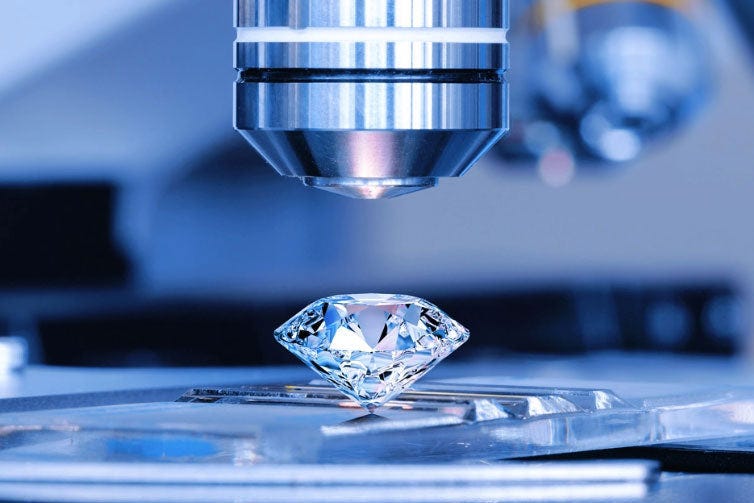
Unlike natural diamonds, which require exploration, mining, sorting, cutting, and global distribution, LGDs bypass the mining process entirely. Produced in controlled laboratory environments using advanced techniques, they offer identical physical and chemical properties in a significantly shorter time frame. This has made the supply chain more efficient, scalable, and comparatively sustainable. LGDs were priced ~70–80% lower than natural diamonds on a per-carat basis in CY 2023.
LGD manufacturing is capital intensive, creating a natural floor for pricing:
Initial capital investment: ~USD 180,000 per reactor (including CVD machines, generators, cooling systems, and related infrastructure).Capacity: ~180 carats per month; ~1,900 carats annually at ~85% utilization.Annual operating cost: ~USD 51,300 per reactor.Estimated operating profit: ~USD 15,000 per reactor (~8% RoIC in CY 2023).
Rough LGDs are sold to polishers, who operate at ~30–35% margins. After polishing and certification, stones move to jewellery manufacturers and then retailers, with value addition occurring at each stage.
By the time a 1-carat LGD reaches retail:
Wholesale polished price: ~USD 200–250 per caratJewellery manufacturer selling price: ~USD 650–700 per caratRetail price to end consumer: ~USD 1,100 per caratRetail operating margins: ~30–35%
Strong Capital Inflows Driving LGD Growth: Active Funding, M&A and IPO Momentum
Recent fundraising activity in the LGD sector
Globally, the LGD sector has seen rising capital inflows and strategic activity. Companies such as Diamond Foundry have raised significant venture funding, while brands like Brilliant Earth have listed publicly with a strong focus on lab-grown offerings. Large legacy players such as De Beers have also entered the segment through their lab-grown brand Lightbox, signalling mainstream acceptance.
In India, listed players such as Goldiam International have scaled their presence in lab-grown diamonds, while new-age brands like GIVA have raised growth capital to expand their LGD portfolios. Private equity interest has also strengthened, illustrated by Blackstone’s acquisition of International Gemological Institute and its subsequent public listing. At the same time, players such as BlueStone moving towards public markets reflect rising institutional and investor confidence. Together, these developments signal that LGDs are increasingly being viewed as a scalable and investable segment within the broader jewellery industry
Risks and Challenges Associated with the LGDs
Alongside its lucrative advantages and opportunities, there are some regulatory and other challenges in the space, including:
Price volatility: Fluctuations in global diamond prices can reduce trading activity and lower demand for certification, particularly during weak market cycles.Advancing synthetic and treatment technologies: Rapid improvements in lab-grown production and stone treatments make detection more complex, requiring continuous investment in advanced equipment and skilled experts.Reputation sensitivity: Any instance of grading errors, fraud, or ethical lapses can significantly damage credibility and trust.Counterfeit certificates: Fake certifications undermine market trust and necessitate ongoing upgrades in security and authentication systems.Macroeconomic and geopolitical risks: Economic downturns, supply chain disruptions, or conflicts in key diamond regions can reduce jewellery demand and impact certification volumes.Environmental and ethical concerns: Growing scrutiny around mining practices and sourcing standards may shift consumer preferences, affecting demand for natural diamond-related services.
Future Outlook & Scenarios
Looking ahead, lab-grown diamonds are expected to deepen their presence in the global jewellery market rather than remain a fringe category. According to Bain & Company, lab-grown stones accounted for roughly 14% of global diamond jewellery sales by value in 2023, and their share could approach 20% by 2030 as consumers continue to prioritise affordability and transparency. Falling production costs and improving quality are making LGDs increasingly competitive in bridal and fashion segments, particularly in the U.S. and India.
That said, growth is unlikely to be linear. Industry players such as De Beers have highlighted pricing pressure and volatility in the segment, reflecting rising supply and intensifying competition. Over time, the market is expected to consolidate, with stronger brands and efficient manufacturers gaining share. The next phase will likely be defined not just by volume growth, but by how successfully companies differentiate on branding, technology, and trust.
LoEstro Advisors is an investment banking firm specializing in sell-side fundraising and M&A advisory, along with a strong consulting arm. Recognized as the #1 financial advisor in education in India, we are the advisor of choice to India’s blue-chip education businesses.
Over the last four years, we have grown to be one of India’s largest (in terms of M&A transactions) homegrown boutique investment banks, with $1.5 bn+ worth of combined deals closed across education, healthcare, consumer, and technology sectors.